
A Real-World Workflow: From Margin Pressure to Leadership Action
Imagine a hospital leadership meeting on Monday morning. The CFO asks: “Why is EBITDA margin under pressure, and what should we do this week?” HULQ is being designed for the workflow that should follow next.
The gap between reporting and action
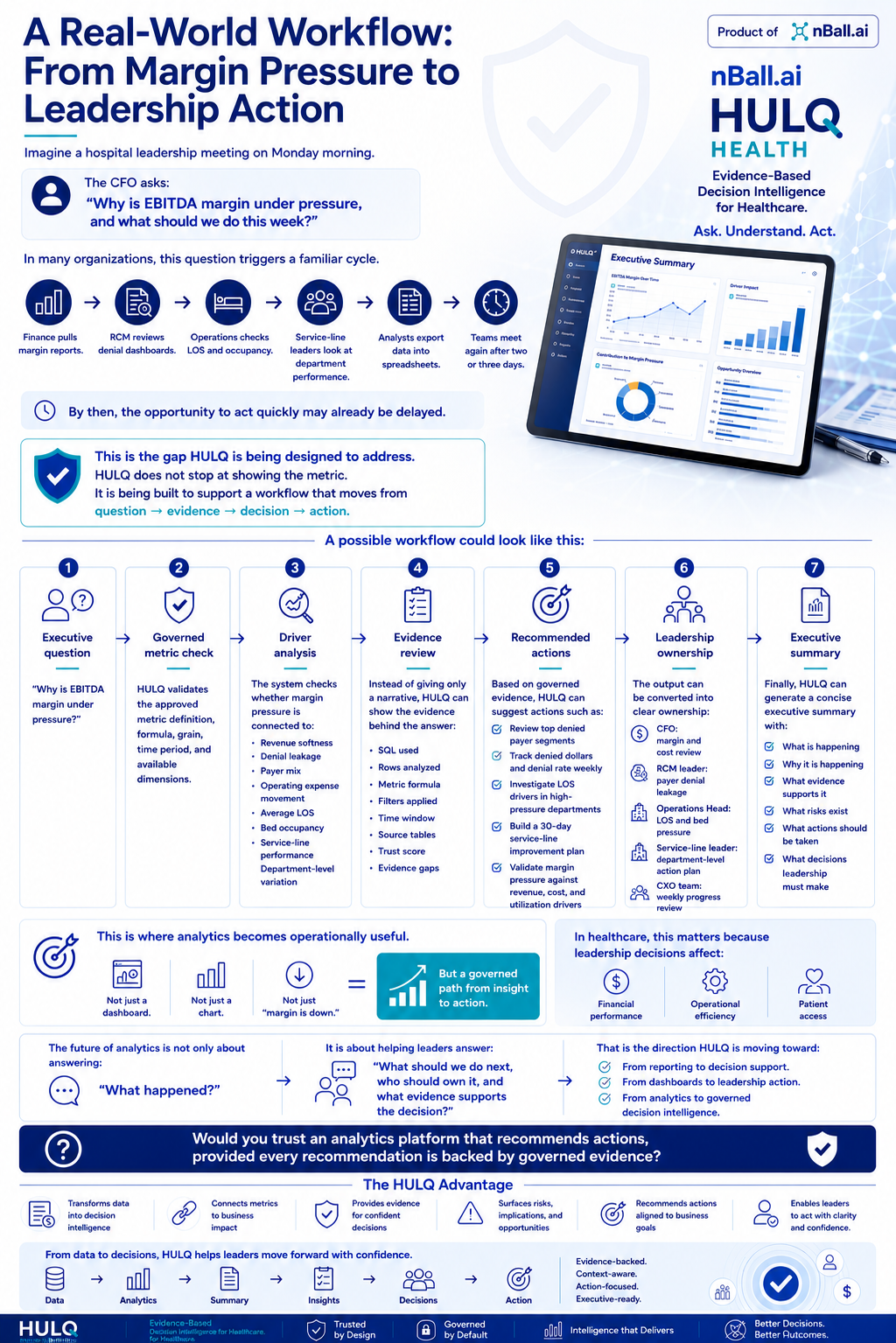
In many organizations, that single leadership question instantly fractures into separate streams of work. Finance pulls margin reports. Revenue cycle reviews denials. Operations checks length of stay and occupancy. Service-line leaders inspect department performance. Analysts export data into spreadsheets and teams reconvene after days of assembly. By the time the conversation comes back together, the window to act may already be slipping.
This is the gap HULQ is being designed to address. Not by replacing leadership judgment, and not by hiding complexity behind fluent language, but by making the path from question to evidence to decision to action more governed, visible, and operationally useful.
What the workflow should become
HULQ does not stop at showing the metric. The intended workflow is a governed decision path:
- Executive question: Why is EBITDA margin under pressure?
- Driver analysis: Revenue softness, denial leakage, payer mix, operating expense movement, average LOS, occupancy, service-line performance, and department variation.
- Evidence review: SQL used, metric definitions, filters applied, source tables, trust scores, and evidence gaps.
- Recommended actions: Review denied payer segments, investigate LOS drivers, track denial trends, and form targeted improvement plans.
- Leadership ownership: CFO, RCM, operations, service-line leaders, and CXO teams aligned around a shared evidence base.
- Executive summary: What is happening, why it is happening, the evidence that supports it, the risks, the decisions required, and the immediate next steps.
Why this matters in healthcare
Healthcare decisions do not affect a dashboard alone. They affect financial performance, operational efficiency, and patient access all at once. That is why the future of analytics cannot stop at “What happened?” It has to help leaders answer: “What should we do next, who should own it, and what evidence supports the decision?”
That is the direction HULQ is moving toward: from reporting to decision support, from dashboards to leadership action, and from analytics to governed decision intelligence.
Would you trust an analytics platform that recommends actions if every recommendation was backed by governed evidence?